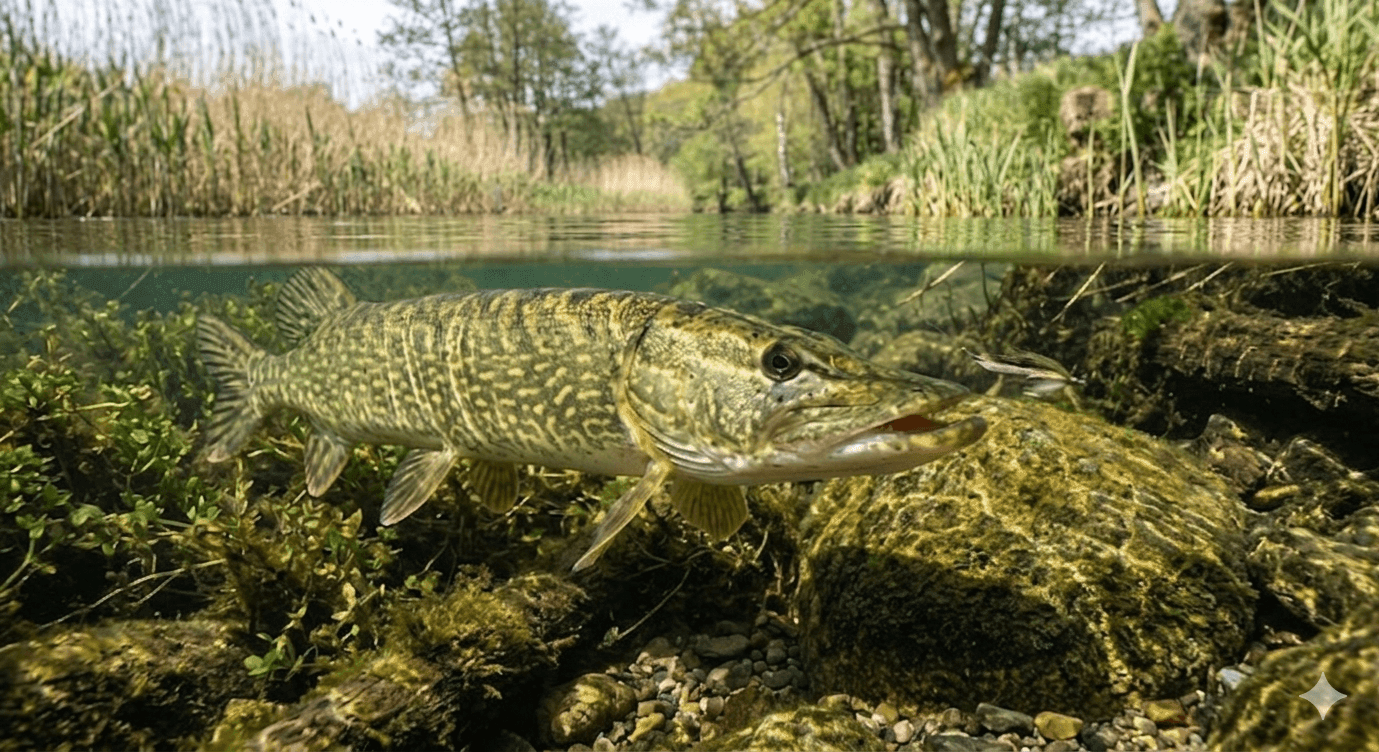
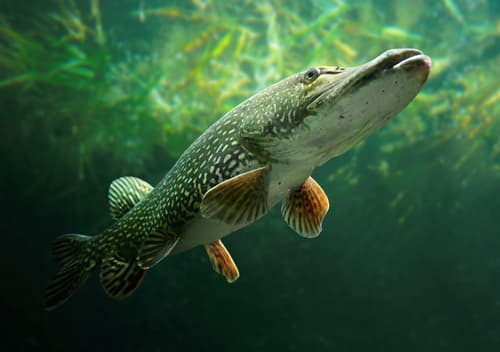
Pike
Esox lucius
Europe's apex freshwater predator — pike fly fishing with heavy streamers delivers savage takes and battles with one of the river's most formidable hunters.
Slow-moving rivers, backwaters, lakes, and fenland drains. Favours areas with abundant cover: weed beds, lily pads, fallen trees, and bridge pilings.
40–100 cm, typically 2–8 kg; large females in productive still waters regularly exceed 15 kg.
Esox lucius
Virtually pan-European, from Ireland east to Siberia. Notable fly fishing waters include English fens, Thames backwaters, Irish loughs, and Swedish and Finnish lakes.
Pike fly fishing has undergone a revolution over the past two decades. Once the exclusive domain of spinning and bait gear, pike are now pursued by specialist fly fishers with 9- and 10-weight rods, articulated streamers the length of a human hand, and a level of technical sophistication that rivals any discipline.
The pike's appeal is primal. It is an ambush predator, an apex species in its ecosystem, and it attacks flies with a violence that makes the take visible and explosive unlike anything in trout fishing. A large pike taking a streamer in clear water — the explosion from a weed bed, the flash of that enormous mouth — is one of the most spectacular moments available to a freshwater angler.
The craft of pike fly fishing centres on reading water to locate fish (which hold in predictable ambush lies year-round), presenting large flies accurately to those lies, and mastering the stripping retrieve that provokes attack. The strike is fundamentally different from trout — a firm strip-strike with the line hand, not a rod tip lift, to drive the hook through the pike's hard, bony mouth.
Musėlinės žūklės taktika
Casting to Structure
Pike hold in ambush against structure: weed edges, fallen trees, bridge pilings, reed margins. Approach silently by boat or wading, casting tight to the structure and retrieving the fly past the pike's lie. Vary retrieve speed and pattern until you find what triggers a response. The last foot of retrieve near the boat often produces follows, so hold the fly at the rod tip and slowly figure-eight retrieve before picking up.
Water Column Fishing with Intermediate Lines
Pike suspended in the mid-water column (common in warmer months over deep water) are best presented to with an intermediate sinking line and a neutrally buoyant or slow-sinking streamer. Retrieve in long strips with pauses. Tungsten-weighted articulated flies that dive and dart on the strip are ideal.
Spring Shallow Water Sight Fishing
Post-spawn pike (April–May) move into extremely shallow water to recover and feed aggressively. Polarising glasses are essential. Cast well ahead of any cruising fish, retrieve the fly across their path at moderate speed, and expect follows all the way to the bank.
Rekomenduojamos musės
Geriausi mėnesiai
Kur žvejoti

Kitos rūšys
Brown Trout
Salmo truttaThe most iconic freshwater fish in European fly fishing — wary, selective, and endlessly fascinating.
Atlantic Salmon
Salmo salarThe king of rivers — a powerful anadromous fish that returns from the ocean to spawn in its birth river.
Grayling
Thymallus thymallusCalled the "Lady of the Stream" — the grayling extends the fly fishing season deep into winter with year-round sport.
Sea Trout
Salmo trutta truttaThe sea-run form of brown trout — a nocturnal predator that enters rivers silver-bright and fights with extraordinary power.
Rainbow Trout
Oncorhynchus mykissIntroduced from North America, the rainbow now thrives across Europe and offers acrobatic sport in rivers, lakes, and reservoirs.