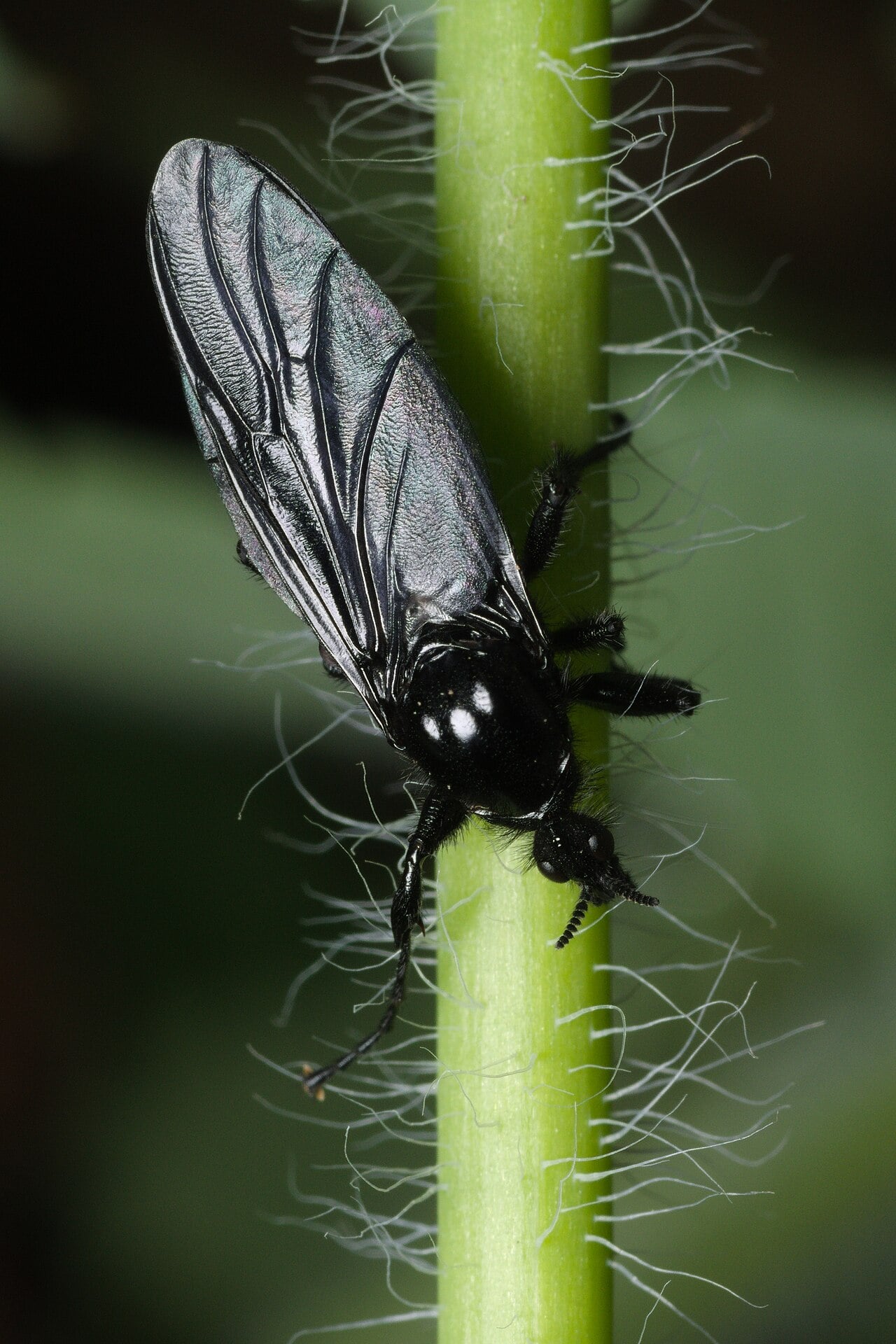
Hawthorn Fly
Terrestrials

Hawthorn Fly

Bibio marci St Mark's Fly, Hawthorn, Bibio

Named for St Mark's Day (25 April), the Hawthorn Fly arrives like clockwork in late April — a short, intense window of spectacular surface feeding.


Būrys

Terrestrials — Terrestrial

Šeima

Bibionidae

Dydis / Kabliukas

Body 10–14 mm / Hook size 12–14

Aktyvumo laikas

All day when present (terrestrial — wind-dependent)

Vandens tipas

Any water adjacent to hawthorn, blackthorn, and hedgerow vegetation — chalk streams, limestone rivers, lakes

Gyvenimo ciklas

The Hawthorn Fly is entirely terrestrial — its larva lives in the soil feeding on decaying plant material and grass roots, and spends the winter as a prepupa before emerging as an adult in April and May. The adult is a large, black, clumsy fly immediately recognisable by its distinctive long, dangling hind legs which it carries trailing below its body in flight.

Adults emerge synchronously from hawthorn hedgerows, scrub, and woodland edges in April, typically appearing within a few days either side of St Mark's Day (25 April) each year — a reliability that gave the species its common name. Mating swarms form above hawthorn bushes and hedgerows on warm, still days. The adult is a poor flier; any wind blows them onto adjacent water.

There is no aquatic phase whatsoever — the fly is purely a windfall food for fish. But its reliable timing, distinctive silhouette, and ability to appear in large numbers over a two-week window makes it one of the most important events in the early spring dry fly calendar. The season is brief but intense.


Aktyviausi mėnesiai
April
May

The Hawthorn Fly is the fly fisher's most reliable early-season terrestrial. Trout, grayling, and chub that have been confined largely to sub-surface feeding through the winter suddenly encounter a large, helpless black fly struggling on the surface — a significant food item that is easy to identify, easy to locate, and (in principle) easy to imitate.

The most visible characteristic is the the trailing hind legs. This silhouette is key to the fly's recognition by fish — tie a Hawthorn without the trailing legs and results will be notably poorer on selective chalk stream fish. The long, knotted pheasant tail fibre legs hanging below the hook are not decorative; they are functionally critical.

Hawthorn Fly fishing is most productive on rivers bordered by hawthorn and blackthorn hedgerows — the classic chalk stream and limestone river valleys of southern England, Wales, and Ireland. On chalk streams like the Test, Itchen, and Kennet, the Hawthorn Fly provides some of the best dry fly fishing of the season in the brief April window before the main mayfly season begins.

The species and its close relatives are found across Europe wherever the habitat exists. The timing shifts slightly later in northern latitudes and upland rivers — early May in Scotland, mid-May in Scandinavia.


Žūklės patarimai

Follow the Hedgerow

Fish the bank adjacent to hawthorn and blackthorn hedgerows first. Adults blown onto the water congregate along windward banks. Look for the distinctive black flies struggling on the surface and identify rising fish nearby. These fish are usually feeding greedily — the challenge is presentation rather than pattern selection.

The Dangling Legs

A Hawthorn Fly pattern without properly rendered dangling legs will underperform on selective chalk stream fish. Use knotted pheasant tail fibres dropped at least 10 mm below the hook bend to represent the trailing legs. The fly should sit flush in the surface with legs underwater — grease only the body, not the legs.

Wind-Activated Movement

Natural Hawthorn flies struggle continuously on the water. Give your imitation occasional gentle movement by raising and lowering the rod tip millimetres at a time. This barely perceptible twitching mimics the struggling naturals and can make the difference on wary fish that have inspected a static pattern and refused.


Rekomenduojamos musės
Hawthorn Fly (knotted legs)
Bibio Dry
Black Ant (as substitute)
CDC Hawthorn
Black Klinkhammer (size 12)


Pirkite mūsų muses
Mayfly CdC

Mayfly CdC

0,00 €
mayfly-cdc-hook-size-10: 100 vnt.mayfly-cdc-hook-size-12: 110 vnt.
Parachute Adams

Parachute Adams

1,20 €

2,40 €

Likę 2 vnt.
-50%
Foam fly bug test

Foam fly bug test

2,41 €
Likę 10 vnt.
Snowflake Caddis

Snowflake Caddis

4,20 €
Likę 5 vnt.
Riboto leidimo