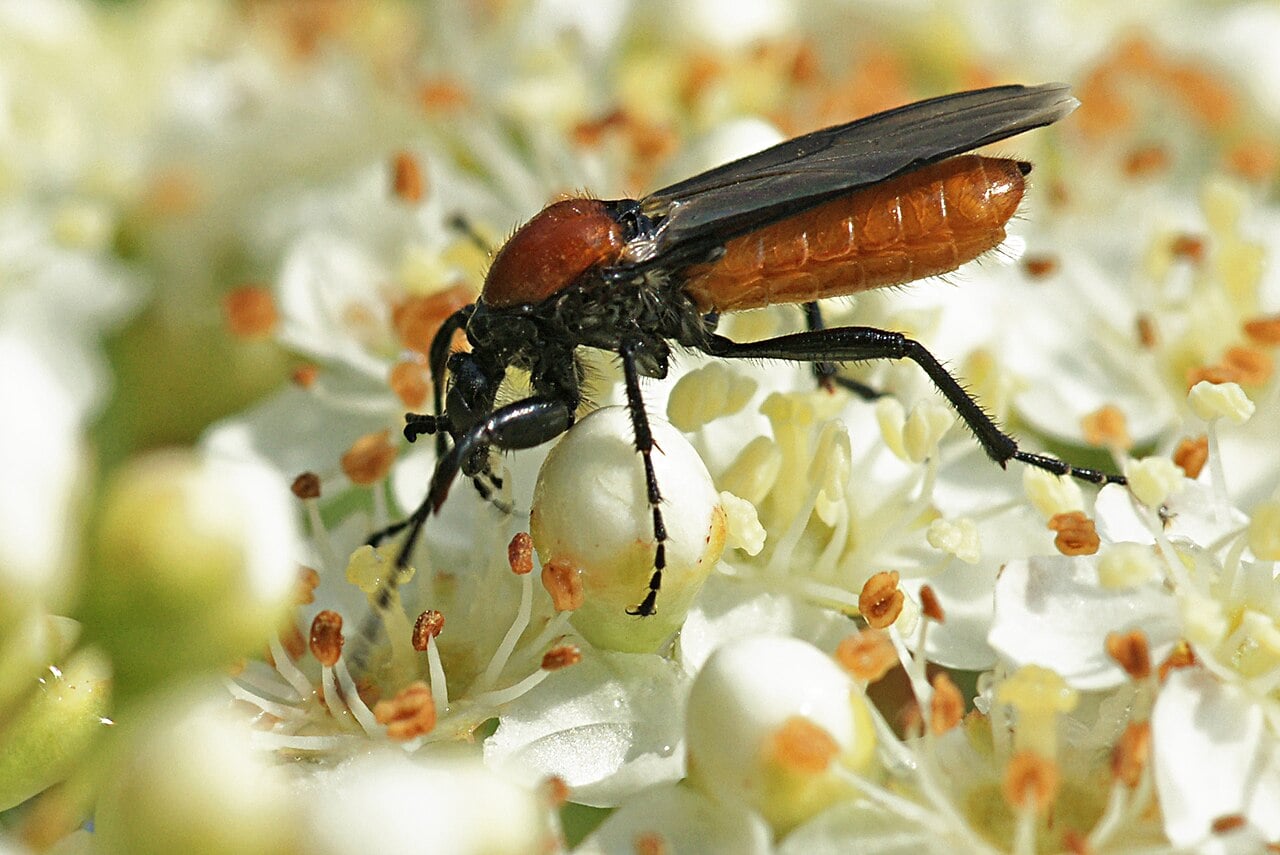
Black Gnat
Bibio johannis — Black Bibio, Blue Black Gnat
A ubiquitous summer terrestrial — the Black Gnat is available to fish on virtually every European river when other hatches are quiet.
Terrestrials — Terrestrial
Bibionidae
Body 5–8 mm / Hook size 16–18
All day when present (terrestrial — blown onto water)
Universal — any watercourse adjacent to vegetation; bridges, tree-shaded runs, and wooded banks concentrate falls
Lifecycle
Bibio johannis, the Black Gnat, is a member of the same family as the Hawthorn Fly (Bibionidae) and shares its terrestrial lifecycle. The larva lives in soil and decaying vegetation, completing its development underground before emerging as an adult in late spring and summer. Adults appear slightly later than the Hawthorn Fly and remain present throughout the summer.
Adults are smaller than the Hawthorn — only 5–8 mm — with a distinctively black, shiny body and clear wings. They swarm and mate over vegetation near water, and individuals regularly land on or fall into the water. Unlike the Hawthorn's brief two-week season, Black Gnats are present and available throughout the summer.
They are not hatching insects in the aquatic sense, so there is no predictable emergence event to key on. Instead, their presence on the water is stochastic — dependent on wind, proximity to vegetation, and population density. However, on overcast summer days when other hatches are sparse, Black Gnats may represent the only significant surface food available, making them an important "search pattern" for summer dry fly fishing.
Peak months
The Black Gnat is the summer dry fly fisher's constant companion — not dramatic like the Green Drake, not technically demanding like the Caenis, but reliably present and reliably taken throughout the summer when rivers are low and warm and more spectacular hatches have dwindled.
Any river or stream bordered by trees, hedgerows, or rough vegetation will have Black Gnats present throughout the summer. Overhanging trees concentrate falls — look for fish tucked under willows and alders, rising to gnats and other small terrestrials dropped by the wind and spiders' silk from overhanging branches.
The Black Gnat is also a useful "when nothing is happening" pattern. When no hatch is visible and fish are not actively rising, a size 16–18 black dry fly cast to likely lies often inspires interest — trout and grayling will come up for a small black pattern even when they are not surface-feeding to a specific hatch. This makes it an ideal exploratory pattern for dry fly fanatics who refuse to nymph when the water is calm.
Virtually universal across Europe in suitable habitat from May through August. The closely related Simulium blackfly (Reed Smut) fills a similar role on chalk streams in late spring.
Fishing tips
Under the Trees
Target the shaded runs under overhanging alders, willows, and hawthorn. Fish lie in the cooled water in summer heat and feed opportunistically on insects falling from branches above. Tight casting under branches is required — a 3-weight rod with a short, accurate leader places a size 16 Black Gnat precisely where it needs to be without disturbing the lie.
Upstream Stalking
On low summer rivers, walk slowly upstream wearing polarised sunglasses, looking for individual fish. A single well-placed size 16–18 Black Gnat to a sighted rising fish is far more productive than blind-casting from the bank. This is a hunting approach — slow, deliberate, and very satisfying.
Black Gnat vs Reed Smut
On chalk streams in May–June, fish sometimes refuse a Black Gnat impersonation in favour of even smaller Reed Smut imitations (size 18–22, black with a slightly humped thorax). If fish are rising to something invisible, scale down to a size 20 midge-style black CDC fly and fish it carefully.
Fly patterns
Target species
Shop Our Flies
Other hatches
MayfliesGreen Drake
Ephemera danicaThe iconic mayfly of British chalk streams — its annual emergence signals the most celebrated fortnight in fly fishing.
MayfliesBlue Winged Olive
Serratella ignitaThe most important small olive on British and European chalk streams — reliable, widespread, and technically demanding.
MayfliesMarch Brown
Rhithrogena germanicaThe first major hatch of the European fly fishing season — a welcome sight on cold, rocky rivers in early spring.
MayfliesIron Blue Dun
Nigrobaetis nigerThe fly fisher's dark secret — a small, near-black mayfly that hatches prolifically in cold, blustery conditions when nothing else is on the water.
MayfliesCaenis / Angler's Curse
Caenis horariaThe infuriatingly tiny mayfly that hatches in such vast numbers that fish refuse to look at anything larger — the tying and presentation challenge of a lifetime.


