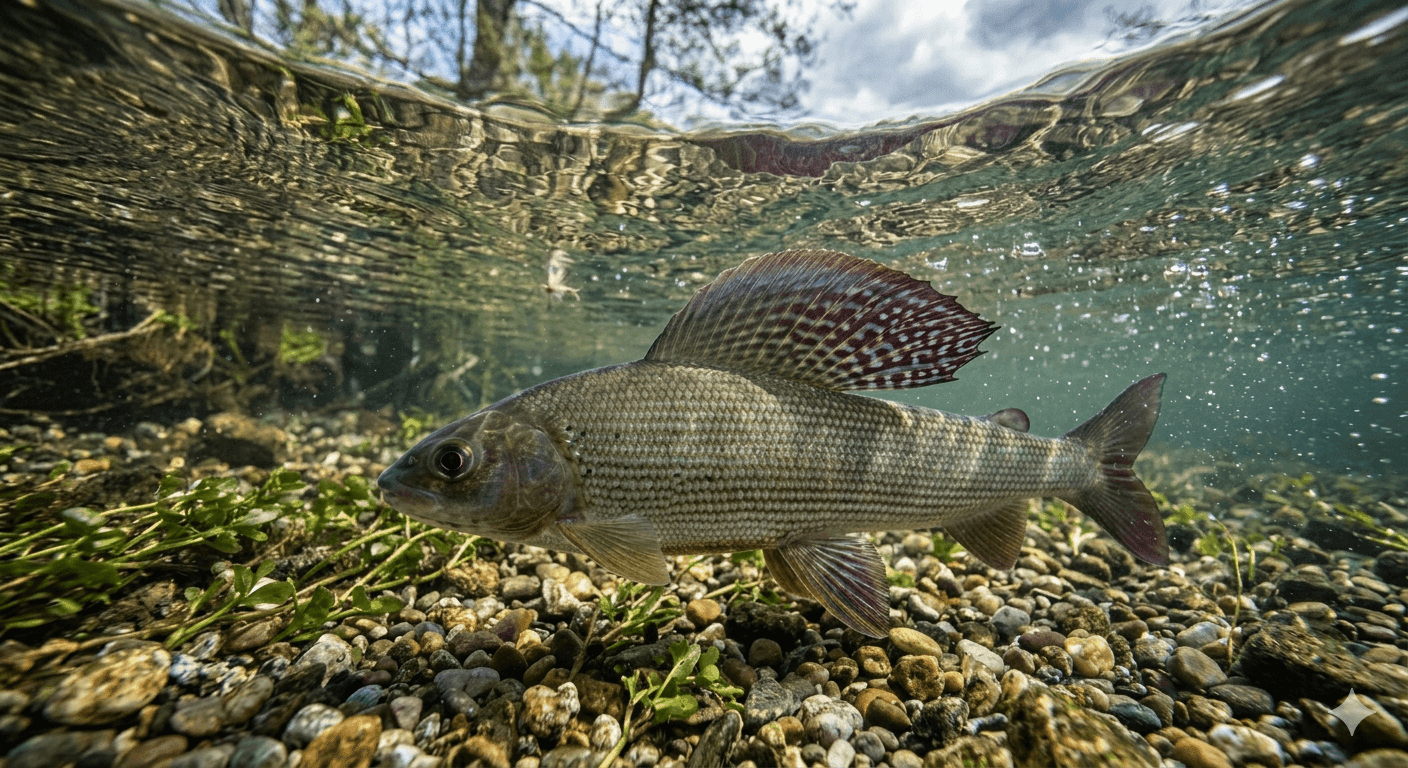
Grayling
Thymallus thymallus
Called the 'Lady of the Stream' — the grayling extends the fly fishing season deep into winter with year-round sport.
Clear, fast-flowing rivers with gravel or chalk substrates. Thrives in colder water than trout and remains active through winter.
25–50 cm, typically 300–900 g; exceptional fish in productive chalk streams can exceed 1.5 kg.
Thymallus thymallus
Central and Northern Europe: chalk stream valleys of England, Alpine rivers of Austria and Germany, Scandinavia and Eastern Europe.
The grayling is the fly fisher's winter friend. While trout retreat to deeper, slower water and cease feeding actively in the cold months, grayling feed all year — often most willingly in November, December, and January when nothing else is in season.
Distinctly marked with a spectacular sail-like dorsal fin of iridescent purple and pink, the grayling is arguably the most beautiful freshwater fish in Europe.
Fly fishing tactics
Czech and French Nymphing
The most effective technique for winter grayling. Czech nymphing with two heavy beadhead nymphs (sizes 12–16) fished tight-line is devastating. French leader techniques allow longer-range nymphing in wider rivers.
Dry Fly in Autumn
Grayling will rise freely to small dry flies in autumn — sometimes more willingly than in summer. Sizes 16–20 in grey, olive, or orange work well.
Recommended flies
Best months
Other species
Arctic Char
Salvelinus alpinusA relic from the last Ice Age — the arctic char inhabits the coldest and deepest lakes of Northern Europe and offers pure wilderness fly fishing.
Asp
Leuciscus aspiusA fast, aggressive surface predator unique to European rivers — asp fly fishing combines the excitement of sight fishing with explosive surface takes.
Atlantic Salmon
Salmo salarThe king of rivers — a powerful anadromous fish that returns from the ocean to spawn in its birth river.
Barbel
Barbus barbusA powerful bottom-feeding river specialist whose strength in fast current makes it one of Europe's most underrated fly-rod fish.
Brown Trout
Salmo truttaThe most iconic freshwater fish in European fly fishing — wary, selective, and endlessly fascinating.