Grannom
Brachycentrus subnubilis — Green Tail Caddis, Green Flag Caddis
The first major caddis of the year — appearing in huge April swarms, the Grannom kick-starts the surface fly fishing season on chalk streams.
Caddisflies — Trichoptera
Brachycentridae
Body 7–10 mm / Hook size 14–16
Midday
Chalk streams and moderate-paced gravel rivers; hatches on the same beats year after year
Lifecycle
The Grannom larva builds distinctive square-sectioned cases from fine sand grains and plant material, attaching them to weed beds and stones on the river bed. The larva feeds on algae and fine organic matter using filtering setae on its forelegs — a strategy ideally suited to the current-rich chalk stream environment where food is constantly delivered to the stationary larva.
The pupal stage lasts approximately two weeks. When ready to hatch, the pupa cuts free from its case and typically ascends to the surface in mid-water, making it available to subsurface-feeding trout before it even reaches the film. Emergence happens rapidly; the adult caddis appears through the surface film in seconds, dries its wings on the water surface, and takes flight.
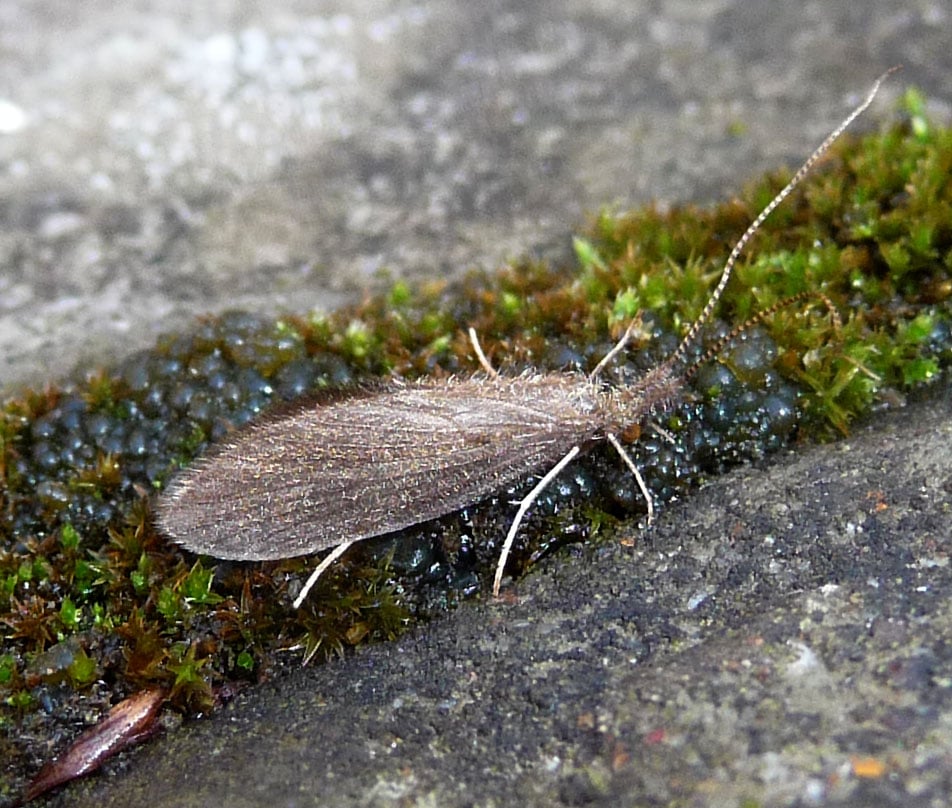
The unmistakable identifier of the Grannom is the bright apple-green egg sac carried by the female on her abdomen before oviposition. Egg-laying females returning to the water to deposit eggs provide a second — often more intense — feeding opportunity as they touch the surface repeatedly. The collapsed egg sac after laying leaves a distinctive green spot that trout key on closely.
Peak months
The Grannom hatch in April is one of the great spectacles of the chalk stream season. On a warm April morning, the surface suddenly fills with dozens, then hundreds of small brown caddis with distinctive bright green egg sacs at their tails. After a winter of mostly sub-surface feeding, trout explode to the surface for what may be the first serious dry fly opportunity of the year.
Brachycentrus subnubilis is a reliable and calendar-precise hatch — anglers who know their water are often in position on specific beats within a day or two of the same date each year. The hatch may last only a few hours at its peak but the concentration of activity can be extraordinary, with multiple fish rising simultaneously in the same riffle.
Beyond the UK chalk streams, the Grannom (and closely related species) appears on moderate-gradient rivers throughout Western Europe, including rivers in France, Belgium, the Netherlands, and throughout Central Europe's limestone stream systems.
For the angler, understanding the timing is everything. The main dun emergence in midday is productive, but the egg-laying flight of the females in the afternoon — when green-tagged caddis repeatedly touch the surface to deposit eggs — often produces more selective and intense rising than the emergence itself.
Fishing tips
The Emerging Pupa
Start with a Grannom Pupa or Cased Caddis Nymph in the hour before surface activity begins. Ascending pupae are easy targets for trout; fish the nymph on a dead-drift just below the surface film, then skate it upward through the film to mimic a pupa breaking through. Takes are often abrupt.
Matching the Adult
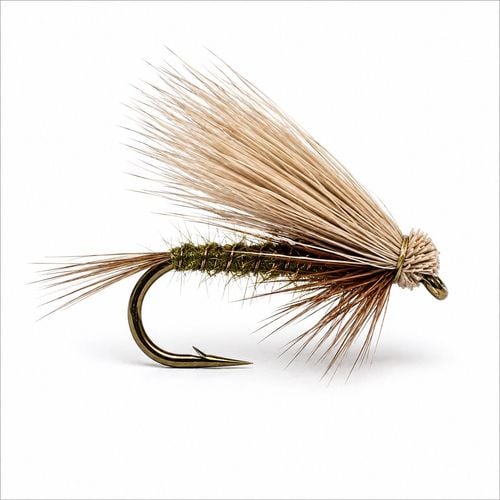
A size 14–16 Elk Hair Caddis or dedicated Grannom dry with a small green-dyed wool blob at the abdomen tip is the classic surface pattern. Brown-winged caddis dry flies are largely interchangeable at this size; the key is a flush-riding profile that doesn't sit too high on the film.
The Egg-Laying Female
In the afternoon, watch for females repeatedly dipping to the surface. These fish are not always easy to identify from the bank — look for the quick, sipping rise. A size 16 CDC caddis with a visible green tag, cast to rising fish from downstream, is the most effective approach during this phase.
Fly patterns
Target species
Shop Our Flies
Other hatches
MayfliesGreen Drake
Ephemera danicaThe iconic mayfly of British chalk streams — its annual emergence signals the most celebrated fortnight in fly fishing.
MayfliesBlue Winged Olive
Serratella ignitaThe most important small olive on British and European chalk streams — reliable, widespread, and technically demanding.
MayfliesMarch Brown
Rhithrogena germanicaThe first major hatch of the European fly fishing season — a welcome sight on cold, rocky rivers in early spring.
MayfliesIron Blue Dun
Nigrobaetis nigerThe fly fisher's dark secret — a small, near-black mayfly that hatches prolifically in cold, blustery conditions when nothing else is on the water.
MayfliesCaenis / Angler's Curse
Caenis horariaThe infuriatingly tiny mayfly that hatches in such vast numbers that fish refuse to look at anything larger — the tying and presentation challenge of a lifetime.