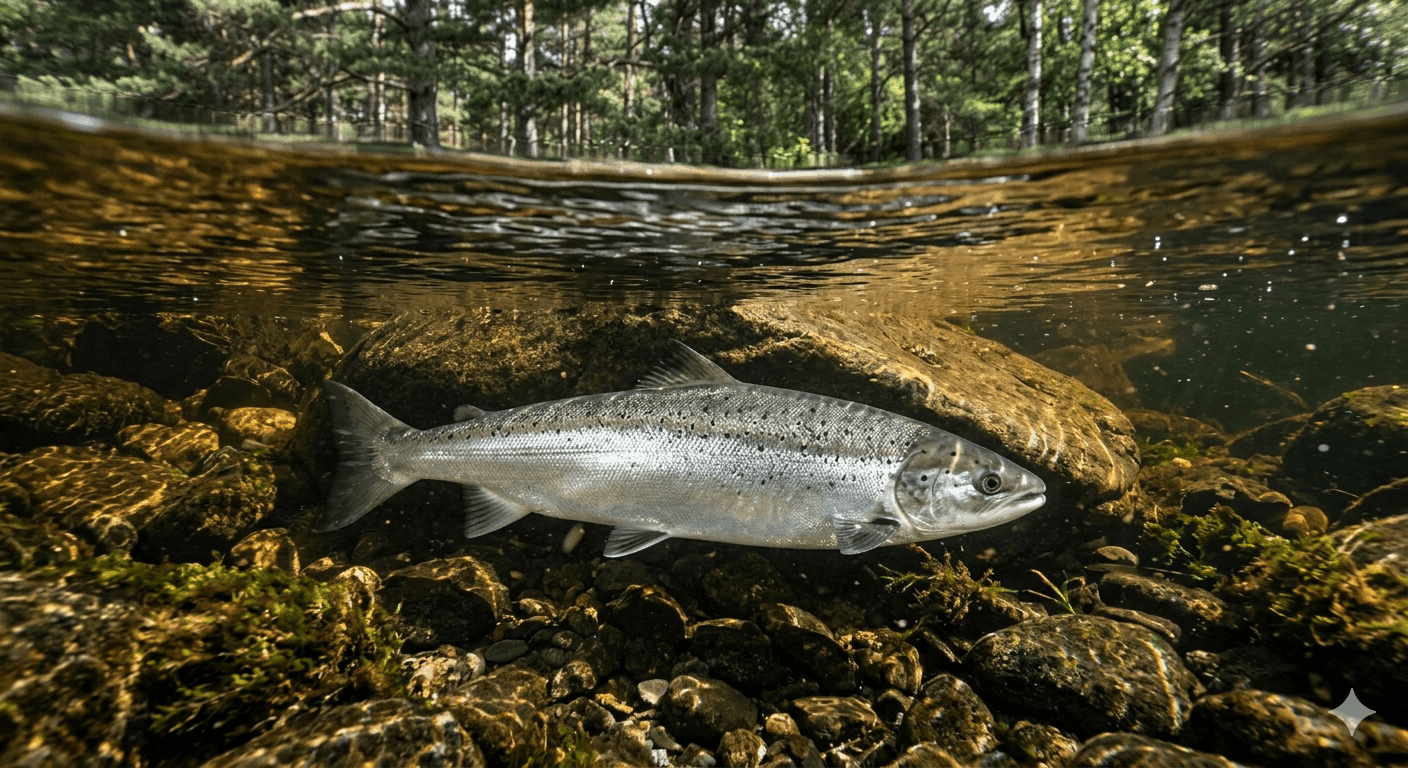
Atlantic Salmon
Salmo salar
The king of rivers — a powerful anadromous fish that returns from the ocean to spawn in its birth river.
Large, fast-flowing rivers with clean, cool water and gravel spawning beds. Adults spend years at sea before returning to spawn.
60–120 cm, typically 3–8 kg; multi-sea-winter fish can exceed 20 kg.
Salmo salar
Rivers flowing into the North Atlantic — Norway, Iceland, Russia, Scotland, Ireland, England, Wales, France, Spain.
The Atlantic salmon is the pinnacle of European riverine fly fishing. Entering fresh water from the sea with no intention of feeding, it must be provoked or irritated into taking a fly through predatory instinct, territorial aggression, or remembered habit.
Salmon runs historically occurred in most rivers from Portugal to Siberia. Today the population is concentrated in Norway, Iceland, Russia's Kola Peninsula, Scotland, and Ireland.
Fly fishing tactics
Fly Selection by Water Temperature
Water temperature dictates everything in salmon fishing. Cold water below 8 °C calls for large, heavy tube flies or size 2–6 doubles fished deep and slow. As temperatures rise toward 15 °C, switch progressively to smaller, lighter flies.
Swing and Across
The traditional spey-casting technique: cast across and slightly downstream, let the fly swing through the arc on a tight line. Long two-handed rods excel on large Scandinavian and Scottish rivers.
Recommended flies
Best months
Other species
Arctic Char
Salvelinus alpinusA relic from the last Ice Age — the arctic char inhabits the coldest and deepest lakes of Northern Europe and offers pure wilderness fly fishing.
Asp
Leuciscus aspiusA fast, aggressive surface predator unique to European rivers — asp fly fishing combines the excitement of sight fishing with explosive surface takes.
Barbel
Barbus barbusA powerful bottom-feeding river specialist whose strength in fast current makes it one of Europe's most underrated fly-rod fish.
Brown Trout
Salmo truttaThe most iconic freshwater fish in European fly fishing — wary, selective, and endlessly fascinating.
Carp
Cyprinus carpioThe most exacting warm-water sight-fishing challenge in Europe: shallow-water carp reward stealth, accurate casting, and nerve.