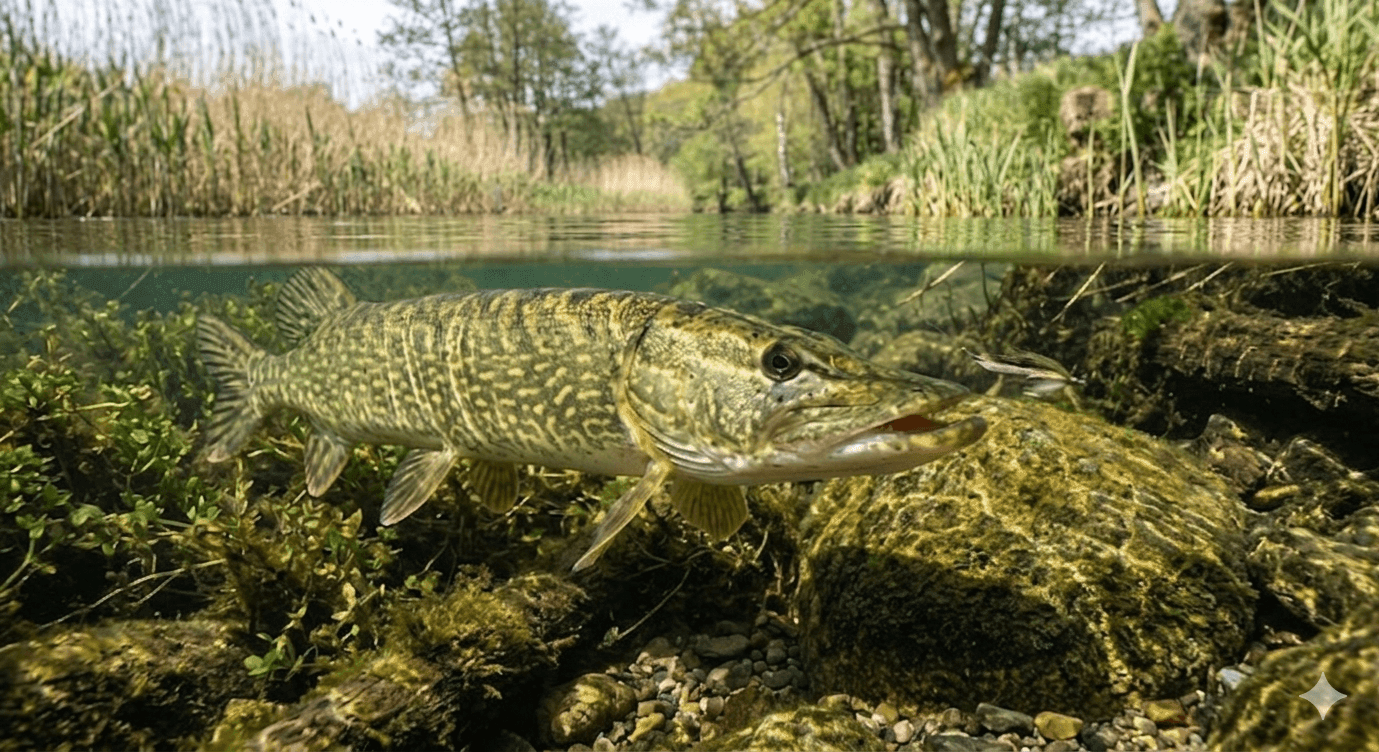
Pike
Esox lucius
Europe's apex freshwater predator — pike fly fishing with heavy streamers delivers savage takes and battles with one of the river's most formidable hunters.
Slow-moving rivers, backwaters, lakes, and fenland drains. Favours areas with abundant cover: weed beds, lily pads, fallen trees.
40–100 cm, typically 2–8 kg; large females in productive still waters regularly exceed 15 kg.
Esox lucius
Virtually pan-European, from Ireland east to Siberia. Notable fly fishing waters include English fens, Thames backwaters, Irish loughs, and Swedish and Finnish lakes.
The pike's appeal is primal. It is an ambush predator, an apex species in its ecosystem, and it attacks flies with a violence that makes the take visible and explosive unlike anything in trout fishing.
The craft of pike fly fishing centres on reading water to locate fish, presenting large flies accurately to those lies, and mastering the stripping retrieve that provokes attack.
Fly fishing tactics
Casting to Structure
Pike hold in ambush against structure: weed edges, fallen trees, bridge pilings, reed margins. Approach silently, casting tight to the structure.
Water Column Fishing with Intermediate Lines
Pike suspended in the mid-water column are best presented to with an intermediate sinking line and a neutrally buoyant or slow-sinking streamer.
Recommended flies
Best months
Other species
Arctic Char
Salvelinus alpinusA relic from the last Ice Age — the arctic char inhabits the coldest and deepest lakes of Northern Europe and offers pure wilderness fly fishing.
Asp
Leuciscus aspiusA fast, aggressive surface predator unique to European rivers — asp fly fishing combines the excitement of sight fishing with explosive surface takes.
Atlantic Salmon
Salmo salarThe king of rivers — a powerful anadromous fish that returns from the ocean to spawn in its birth river.
Barbel
Barbus barbusA powerful bottom-feeding river specialist whose strength in fast current makes it one of Europe's most underrated fly-rod fish.
Brown Trout
Salmo truttaThe most iconic freshwater fish in European fly fishing — wary, selective, and endlessly fascinating.